Showing posts sorted by relevance for query kekes. Sort by date Show all posts

Thursday, January 29, 2009

Political Thinking


I occasionally run Alternate History narratives through my head, about my own life. If I had not made the choices I made, etc. One of the late-life interests I might have taken on earlier is politics. Not running for office or anything like that, but constitutional law. American, not Californian*!

I just finished John Kekes' The Art of Politics, several of whose other works I have gone through in the last years: Against Liberalism, A Case for Conservatism, Illusions of Egalitarianism, The Roots of Evil, as well as various articles.

He is a philosopher in the Anglo-American analytic tradition, which has dominated the philosophy departments of public and secular universities in North America for many decades. It is not a school of thought I much liked during my philosophy-studying days. I got a C in metaphysics while at Columbia because the professor, of the aforementioned tradition, was so mind-numbingly dry and boring, and trivial, I thought, that I simply stopped studying as a form of adolescent protest.

The analytic tradition tries to stick with ordinary language, use logic and reason, and respect science. Though Kekes' style --very careful and workmanlike-- aims for clarity over verve, and it takes some perseverance to think in such a pedestrian** way, I have found his approach to political thinking very enlightening, and pretty congenial. His work is not so different from his politics: not flashy, but careful, responsible and trying to pay attention to reality, in all its complexity.

It does not mean he lacks passion, which shows up in print only once in a while and thus more memorable for its infrequency. He is a determined and convinced enemy of the ideologies of egalitarianism, whose seductiveness and pervasiveness in the liberal West he deems to be a great danger to the political goods which have made our civilization so successful.

Aside from his very skeptical attitude toward religion (one reviewer calls him "tone-deaf" on the subject), he stands in the wider conservative stream coming from Edmund Burke and continued by such folks as Russell Kirk, but with an American specificity. Kekes must be commended as well for his ability to tolerate the intolerant realm of American academia, where he has been a minoritarian figure in a sea of liberals.

I hope to blog about the book over the next while. The title illuminates his thesis, that politics is an art, not a science and especially not that pseudo-science, political ideology. Ideology is so pervasive in politics on the left that many liberals assume that conservatism must be an ideology, the work of "hard-right ideologues." But most conservatives, who are happy to lay out principles, would say that the heart of conservatism is that it has no ideology. Kekes makes that case intelligible.

In outline, he holds that a political philosophy is ideological if it grants to one value (or to a small group of values) the highest place in a hierachical way of thinking about politics. Libertarianism is ideological in that respect, since it privileges individual liberty above all. And certainly Marxism is an ideology of hard-despotic egalitarianism, the parent of our Western soft-despotic liberalism. I suspect he would be quite critical of the crusade to plant Western democracy in the Middle East, as neo-conservatives would have us do. A nice idea, but how realistically adapted is it to places which lack the presumptions that allow it to work, which value quite different political goods?

What also comes to my mind is the post-Vatican II Catholic shorthand, enshrined in the titles of so many nuns' and priests' commissions, "Justice and Peace". Given the lingo, such endeavors quickly become ideological and most of them --all of them?-- follow a leftist line of overt or covert Liberation Theology, which is Marxist at heart.

Kekes holds that human nature is inherently mixed and that natural contingency and man's flawed character make political arrangements basically defensive (my word, not his) and always needing to be adapted to circumstance. Liberals imagine that conservatives are "hard-liners", when it is their attitude which is strong, but their philosophy is precisely about how to most prudently manage the complexities of change. As well, a preference for valuing historical experience (the best kind of human ethology, reality-based...) over rationalized or revealed programs of change marks most conservatives.

Funny how "conservation" is a virtue for progressives when it comes to trees, but a dark evil when it comes to human political life.

Anyway.

In this book, he makes a list of American "political goods", each of which he then explores. His contention is that all of them constitute our society's complex political framework and all need to be taken into account in a variety of constellations in order to make decent political decisions. Slogan-thinking in politics is attractive, but ultimately unsatisfactory or worse.

I'll try to outline them from time to time.


*The State constitution is over 110 pages long and has been amended well over 500 times; the US Constitution: a mere 4 pages long and only 27 amendments.

**I mean pedestrian in the root metaphorical sense, of having your feet walking on the
ground rather than flying around.

_________________________

Sunday, October 26, 2008

The Politics of Imperfection

Even a few of the folks I know who plan to vote for Barry Hussein O are unnerved by the blind religious quality of so many of his fans. From my viewpoint, he is a man of small actual accomplishment and experience (less than Sarah Palin), with troubling character issues, some repulsive associations, and above all, a set of leftist policies and values that I reject.

As I have said, I am unmoved by his speechmaking. Having been a talker for a living most of my life, I am well aware of how to say nothing well. He often does. As I have said before, were he not half-black, he would not be where he is.

I became a conservative several years ago, after a lifetime as a liberal. I looked for some kind of intellectual framework for my (even to me, startling) conversion and found the most helpful and congenial one in the work of American philosopher John Kekes.

I have not read him completely nor would I say that I am anything at all like an expert in his thought. But what I have read over the years, I have mostly liked.

I have especially appreciated his critical reading of the American Marx (my words, not Kekes'), John Rawls, who powerful influence has helped make American liberalism the dangerous animal that it has become.

In a nutshell, Kekes says:

"Moderate skepticism about general theories in politics; pluralism about traditions, values, and conceptions of a good life; traditionalism; and pessimism about human perfectibility and the eradication of evil jointly define the version of conservatism that is the best alternative to its chief contemporary rivals: liberalism and socialism."

This from a very short piece outlining what conservatism is, according to Dr. Kekes, who has written quite a lot about political and moral philosophy. He takes the ineradicable existence of evil very seriously, holds a traditional and non-utopian view of justice, thinks that history is a far better source of wisdom about political arrangements than is rational or religious ideology, and has played out the problems with and the bad outcomes of the egalitarian fantasies that lie at the heart of modern liberalism.


___________________________________________

Thursday, April 21, 2011

Privatio boni

Political philosopher John Kekes and economist Thomas Sowell both emphasize the importance of scarcity in human affairs. It is, apparently, a constant, and a powerfully determinative one.  Even in what has been the wealthiest society in history, the modern West, there is, in fact, never enough to go around. The current battles over the American budget, deficits and debts, show this. A virtually infinite set of desires chasing after a quite finite set of resources. Sowell trenchantly makes the point:
“The first rule of economics is scarcity: everyone cannot have enough of everything that they want. The first rule of politics is to disregard the first rule of economics.”
***

One of the deepest (of the many) illusions of progressives is that everyone can have enough...be it wealth or rights. Part of that narrative is that bad people are immorally hoarding more than their share of wealth, or power, or rights. And it is the role of good people to take it from them.

Of course, this is a game of infinite regress. As Kekes asks, if the "poor" of America have some kind of entitlement to a share in the riches of their fellow countrymen, with the government as the agent of redistribution, why don't the "poor" of other countries have the same entitlement to a share in the rights of their fellow earthlings? Including the American "poor"*, who, by global standards, are very well off indeed.

I ask the same kind of question to people who seem to think that Mexicans can just move into America and take up residence without permission and then expect to get benefits, etc. What if someone just moved into your house and did the same thing? It's really just an economy of scale difference; the principle is the same. Why should you get to own your own house if you can't own your own country?

Many high-minded people (aka idiots) seem to think that ideas like "the right to private property" is some kind of embarrassment. Of course they always have in mind other people who have more than they do. Reminds me of the definition of a promiscuous person: someone who has more sex than I do.
And yet when it comes to the female gender, ownership "of her own body" is an Unquestionable and Sacred Prime Directive From The Goddess. If you can't own property...and defend your stuff...(whether you do or not) then you have no dignity to stand on and your "freedom" is empty. The right to property is utterly humanistic, utterly basic.

*Sowell often makes an important point that public discourse, especially among the liberals, ignores. The "poor" are not a fixed group. If you follow individuals and even groups over time, you can see that their economic situation changes. A lot of the poor are young, starting out in low-paying jobs. As people get older, they usually get richer. Same for the rich; fortunes change and they are not always the same group.

Monday, February 13, 2012

Ideas and ideologies. Oh, and Jews

Dan Blatt, of GayPatriot, is a huge fan of Ronald Reagan. And Reagan once wrote that "the heart and soul of conservatism is libertarianism." Without falling into the philosophical byways, libertarianism is a political ideology. It is based on non-interference, leaving individuals free to pursue their lives as they see fit, with the government's role restricted to constraining the use of force and protecting against fraud. To my knowledge, no purely libertarian society has ever existed. Ron Paul is pretty much a libertarian.

Anyway, Dan has accused Rick Santorum of repudiating libertarianism and therefore of repudiating Reagan Republicanism.

Well, jeesh, what ever Ron R wrote, he did not govern as a libertarian. I honestly don't think anyone can. That's my problem with ideology, which John Kekes articulated so well for me. The use of a Simple Idea to govern the incredibly complex phenomena of a nation. Or a state or township or stamp club, for that matter.

Jonah Goldberg, a pretty pragmatic conservative with a good sense of humor, recently said that even though conservatives like to believe that they are non-ideological, a la Russell Kirk, they are. And should be. But his ideology consisted of "a checklist of principles".

For someone like Kekes, there are a dozen items on that list...and not in order of importance. It is his stance that the "framework of political goods" is the treasure, the complex interrelations of all these values; in any given situation, some are more important than others, as long as the framework is respected.


Reason as prudence
Plurality of goods
Necessary limits
Limited liberty
Toleration within reason
Justice as having what one deserves
Right to private property
Equality as exclusion of arbitrariness
Political democracy
Legitimate authority
Civility as a social condition

A good idea, but hard to sell. You can't make a slogan out of it.


Speaking of Russell Kirk, he was an anti-ideological Burkean conservative and no friend of neo-conservatism (or the "chirping sectaries" of libertarianism). His fundamental problem with the New Right, "often clever, never wise", was that it was so ideological...but also rather too Jewish.
"Not seldom has it seemed," Kirk declared, "as if some eminent Neoconservatives mistook Tel Aviv for the capital of the United States."
Wherever they go, the Chosen People rarely pass unnoticed. On the left, where most Jews reside politically, we have the oddity of their support for parties which cover their discomfort with Jews by naming Israel as the problem. "We're not anti-Semitic, just anti-Zionist."  And as part of the price of being admitted to the leftliberal club, a lot of Jews join them in this. On the right, you mostly have support for Israel but a current of discomfort with Jews-as-a-group because of their predominance among leftliberals. For every Levin, Prager and Krauthammer, you have ten Chomskys and Zinns...and Streisands.
Midge Decter, director of the Committee for the Free World, called Kirk's line "a bloody outrage, a piece of anti-Semitism by Kirk that impugns the loyalty of neoconservatives." She told The New Republic, "It's this notion of a Christian civilization. You have to be part of it or you're not really fit to conserve anything. That's an old line and it's very ignorant."
There it is, I think. "It's this notion of a Christian civilization." When it comes to Jews --and no news to them, I suspect-- there is always the lurking Gentile/Christian question: Whose side are you really on? A suspicion that many of them, of course, heartily reciprocate.

Saturday, April 16, 2011

Evil and bad

I gave my friend Bill a copy of an interview with John Kekes, whose books on politics have given me a kind of a voice for my own conservative point of view. In it, Kekes asserts that both Christianity and the Enlightenment failed to take evil seriously.

Well, I could see his point about the Enlightenment. A lot of abstract universalizing about the human race when what they really had in mind were white European males. Too much rationality. But Christianity?

Then I realized that he was talking about Augustine, who came to the conclusion that evil could not have an independent existence of its own but was a kind of parasitic emptiness of the good. Jung also found the doctrine of privatio boni impossible to swallow; it wrecked his great friendship with Victor White.

In these days of so much liberal ascendancy, with its implicit assumption of the perfectability of man, it is almost refreshing to hear Christianity criticized for being insufficiently grim!

Sunday, January 18, 2009

Why I'm bothered

I am reading John Keke's new book, The Art of Politics. Kekes is that rare bird, an areligious conservative.

His political philosophy tries to base itself on reason and experience. His fundamental stance is anti-ideological. By ideology he means the privileging of a single value by which political decisions are to be made, regardless of circumstance, and the consequent rationalizing program to organize society. So both the Libertarian stance of making liberty the dominant value and the Communist stance of making equality the dominant value are rejected. To put it in my own demotic way, since the world is messy and people are messy, simple answers in politics make for an even worse mess.

I remember when I was first migrating away from my liberalism around the turn of the century (!), I took on a libertarian stance, but rejected the Libertarian Party as soon as I saw its self-description as "The Party of Principle." I like Jonah Goldberg's wry comment: "As you know, I consider Libertarians to be like Celtic barbarians deployed by British kings in the Middle Ages against the Scots or the French. They are extremely useful for fighting your enemies, but you would never want one to actually sit on the throne." Pretty funny!

Some of Kekes' writing, though clear, is painstakingly careful and abstract, in the way that you expect from philosophers, but which is not always pleasant to read. Oddly, though he is no friend of natural law theory --to him, another ideology-- I often find him sounding like Aquinas. At least in his dialectical mode of argumentation and the careful, step-by-step way in which he proceeds to build up his case.

And a recent review by a religious conservative used exactly the same phrase, "hollow at the core" to reject his work as did a typical liberal professor some years ago. Both find him insufficiently ideological.

It has been his work that has made it clearer to me how a utopian and collectivist egalitarianism lies at the heart of the contemporary left, one which has no ground in either planetary or human nature and which can only be imposed by massive coercion. Its spirit is full of that postmodern contradiction which Stephen Hicks outlined, a militant cultural relativism combined with a highminded absolutist moralism. Puritanical nihilists, the will-to-power disguised as empathy.

He also is very clear and unapologetic in valuing the political order of America as one of the great achievements of mankind. Not because it is perfect but precisely because it has taken into account the inherent imperfection of the world and of human nature and has provided such a wealth of goods of all kinds for us who have the fortune to live in it. For all its ideals, the American Revolution was a conservative and limited one, built on compromise, unlike its high-flying French cousin, from whom all the revolutionary evils of the West has since taken descent.

And the incoming President is the darling precisely of the pomo liberals, those contemporary Copperheads, who have done their level best to supplant the traditional American and messy and imperfect way of proceeding with their own seven-pillared fantasy vision of a better world. Australian John Ray puts in well: "It's the shared hatred of the rest of us that unites Islamists and the Left. American liberals don't love America. They despise it. All they love is their own fantasy of what America could become. They are false patriots."

This is the intellectual background, the proximate context, this morning (!), of "why I'm bothered". The immediate point is discovering that the Muslim woman whom Barak Hussein Obama has invited to take part in his post-inaugural prayer service is president of an organization named as an unindicted co-conspirator in a case involving support of Hamas, etc.


It will be no surprise that the mere participation of a Muslim in this event irks me. And it does not surprise me that he chose a Muslim woman to play the role; politically smart, as usual. But why in the name of God does he choose someone tainted by connections to the very people who would erase us? Giving these people a place on the national horizon is a mistake. Couldn't he find some Sufi imam, whose version of Islam actually does place far more emphasis on the internal jihad against egoism?

Bush was hardly better, so I guess I should not be surprised. But I am upset.

"These people" are completely self-confident and unapologetic and clearly wish to replace our society with their own ideology, and they have found their niche in a gutless liberal West, as the perpetual victims, in order to proceed. Galls me deeply.

And I bet her prayer will not be a self-hating de-racinated blurb like the one we can expect from Rev. Mr. Robinson.

_________________________
Tuesday, March 16, 2010

Non-rational animals


One of the most useful insights I have gleaned from reading philosopher John Kekes is that conservatism is, or should be, anti-ideological. This is partly because ideology is a form of rationalism, that taking of an idea (almost always untested by practice) and imposing it on society as the solution to a problem. A kind of unhinged intellectual obsession. Enforced
equality is now the ideology of choice in the liberal West...a strange obsession for the victors of the Cold War against Marxism, the ideology of enforced equality.

Kekes helped me articulate why my libertarian sympathies never developed into a Libertarian affiliation. Libertarianism is an ideology, the consistent and comprehensive application of the principle of non-coercion. Something, by the way, that has never been tried.

Advocates of gay marriage often have a similar rationalist argument. Ignoring what works and what doesn't in this most complex and crucial area of gender and reproduction, they announce a theorem of equality. Poof. A solution.

It strikes me that we never make decisions in this way about our own lives, or the lives of our families --a non-rational institution if ever there was one. We calculate all kinds of factors, sometimes consciously, sometimes unconsciously or even lazily ("Sorry, that just doesn't work for me"). But we are hardly ever ideological about our most personal interests. Does that bode well for using rationalist and ideological arguments for the larger world?

For example, how many of the white enlightened class in San Francisco, who hold only the most advanced racial views, move heaven and earth to get their kids into a good school, often private?


A lot of the cumulative decisions of many humans over many ages sometimes goes by the name of tradition. In some cultures, that word has positive and even determinative value. But in ours, it is practically pejorative. Because tradition, supposedly, is not rational.

And rationality is better than "blind" or "mere" tradition, which, after all, was made up by all kinds of inferior (and dead) people who were not...us.

It may have been Chesterton who called tradition "the democracy of the dead", since it continued to give a voice to lives that had been live through to the end. I find it ironic that people I know who sigh enviously at how "spiritual" brown and yellow and red people revere their ancestors will, at the slightest inconvenience, dismiss or pathologize their own, often in the forms of life that they have handed down to us, like marriage, for instance.

Since I am a believer in The Fall, I do not grant sinlessness or infallibility to human tradition. But I do, especially as I get older, give it the benefit of the doubt for starters and then try to understand why it turned out as it did. Some things become obvious only with time.

A trivial example. When I was a monk, there was a long tradition of eating meals together but in silence, with one monk reading aloud during the dinner. This inhibited "community connection" and so, during the era of The Church Efervescent, it was largely abolished, along with the long tables, etc. We sat together at smaller tables and talked. All the time. Morning, noon and evening. Do you know how wearisome it is to try to make conversation with people you live with for years and don't even like? God, how I wanted the old way back. It was kind, not cruel.

For all its benefits, one of the things the Enlightenment did, I suspect, was sow the seeds for the de-racination from reality of the Western mind. It helped us believe the Star-Trek-silly notion of "universal human rights" transcending human attachments to soil and tribe and self-interest.

______________________

Saturday, March 30, 2013

Obama and Bush

Obama Uses His Egyptian Disaster to Argue That Israel Should Trust the Terrorists:

One of the flaws Obama shares with George W Bush is the assumption --in public at least-- that "we all want basically the same things."

Hidden in there is the American assumption that all these "basically same things" can be compatible.

First of all, we all want "freedom", but that just translates into my ability to live life among my own kind and not necessarily at all allowing other people to do so. This is part of the abstraction that Westerners are particularly prone to, the huge underestimation --at least in public-- of the archetypal power of blood and soil. One of the many frauds within multiculturalism is that it requires us both to worship and to ignore culture, depending on the situation.

Nobody really believes in Universal Human Rights except Westerners. Everyone else subscribes to them only insofar as it benefits them and their tribe. They are often savages and barbarians and thugs but they are not foolish.

(While I'm at it, with thanks to John Kekes, isn't the existence of separate nations just a global form of segregation? If segregation within a nation is deeply evil, then why is the segregation that is the defintion of nations not just as evil? That is the unasserted assumption within the drive to integrate White nations via massive Third World immigration. )


'via Blog this'

Thursday, July 18, 2013

A little infallible truth for the day

For almost every form of -ism and -phobia that our liberal betters wish to demonize, there is a reason. And usually more than two.

Racism, sexism, homophobia, xenophobia, classism, transphobia, Islamophobia, antiSemitism, looksism, ageism, ableism, even antiziganism!...there are reasons, and good reasons, for all of them.

They are not --as our liberal betters demand that we makebelieve-- simply groundless, baseless, evil attitudes arising from nothing more than groundless, baseless evil minds, without evidence or foundation, massive denials of the blindingly obvious truth of universal equality, (an equality which, for some strange reason, has escape the noticed of the entire human race until ten minutes ago.)

Universal equality. Talk about groundless, baseless, evil attitudes without evidence or foundation! (Young Mr Kurtagic ramps up the critique made by the elder Dr Kekes that egalitarianism is a huge mistake and leads to terrible evil.) "Our common humanity", in the sentimental sense in which it is usually meant, is the least informative and consequential thing about us. It's as meaningful as saying, "All cats are cats!"

And while I'm at it, stereotypes are only offensive because they cut so close to the bone, not because they are insultingly mistaken but precisely because they carry so much truth in them. Each offended group's comedians relies on the truth of the stereotypes to make them laugh. They all see it.

One of the fundamental and unchanging realities of the human species is that we live in groups, groups of all kinds, and that many of these groups --including the most important ones like families and tribes-- are in constant competition and conflict with one another. Competition and conflict are structured into the very nature of the species because of the very nature of the planet on which we have come into being, where death is universal and ever at-hand, and life is marked by scarcity, contingency and flaw. Competition and conflict are not moral flaws in our species character, they are the conditions of our survival, about which we are not given a choice. You may as well condemn humans because we eat organic matter.

Survival is both an individual and a group concern, but a group concern above all, since it is your group(s) that allow you to survive as an individual. So in an important way, it does not matter whether an ism, a phobia or a stereotype is "true". That is a determination that will always be clouded by self-interest and will never convince the Other who is in competition and conflict with you. What matters is to find your group(s) and fight for your survival. Because that's what all the Others are doing.

Everyone who is not a Foolish White Person knows this and lives by it.

---

Saturday, August 18, 2012

Why do they hate us?


It is now cultural dogma that "hate" (or the tiresome gay version, H8) is always wrong, bad and evil. Inexcusable and to be repressed entirely. Hate is the new Lust. Being call a "hater" is another way of instantly invalidating you. (It's like "racist".)

But wishing doesn't make it so. All human emotions make sense, whether you like them or not. And none of them are going away.

One of the fuels that drives hatred is a sense of being under threat. One of the kinds of people or groups or ideas we hate is what threatens us.*

Part of the campaign against hate is a desire to prevent certain groups from noticing or, worse, asserting that they are threatened.

Some threats are fantasied or overdone. Many threats are absolutely real. Paranoia, like so many mental dis-orders, is really just a natural and normal state gone rogue.

Hate often makes sense. And if you disallow that emotion in others, you will never get to understand why they hate you. It's not just because they are bad or defective (though they may be) but because they perceive you as a threat to something they value.

And you very well may be.

It might be instructive to lay down your defensiveness and investigate. Not to make friends or surrender, but to figure out what and how your enemy is thinking. Isn't Sun Tzu supposed to be cool right now?

The outcome of this may not be Kumbaya moral equivalence and Star Trek one-worldism**. You may decide that you are a threat and that's just fine with you. In a world well characterized by John Kekes as full of "scarcity, flaw and contingency", being a threat to someone is well nigh inescapeable. Mother Nature made the rules long before you were born.

So if you find yourself (personally or as a group) hated by someone, ask yourself why...and be prepared to find an answer other than that you are an innocent and blameless object of mindless and irrational hate. Hate often has a clear mind and a functioning reason. But with different interests from yours.

If you are gay, or a Jew, or White, or a Muslim, or Black, or an illegal immigrant, or Republican, poke around a little and some more reality may come your way.

If you really ask Why Do They Hate Us, there's usually an answer.


*Perhaps this is a source of the Christian prohibition of hatred, a recognition that it is rooted in fear. If the Christian religion is true, then a believer cannot be truly, that is, ultimately, threatened by anything human. So there are no grounds for fear, and hence, for hatred of any human.


**Although very entertaining, Star Trek is the epitome of liberal dishonesty. Positing an end to poverty and war and tribalism on earth, through mere technological means that eliminate scarcity, (which it imagined as the source of flaw and contingency), it had to project the drama of violence and competition out onto the galaxy. Otherwise, there'd be no script. They don't call it science-fiction for nothin'.

------

Saturday, March 26, 2011

Dr Evil


Last night two friends got into a discussion of evil. I refrained and just listened. I did notice this, that they restricted themselves to human behavior and human motivation, freedom, responsibility, etc. This focus provokes my Gnostic side, which sees humans as much the victims of the cosmos as perpetrators of evil within it.

One of the typologies of human beings in Gnosticism is the triad: hylic, psychic and pneumatic, or the materialists, the ensouled, and the spirited. Hylic humans live in an entirely material world, dominated by "the iron law of death." Survival is their driving motive and they share a great deal with animals. Psychic humans concern themselves with morality, seeking meaning and salvation in forms of goodness. The classical Christian tension between faith and works is typical of these folks. The spirited humans, who are capable of Gnosis, transcend domination by either death or the law because they come to know who they most deeply are.

Be that as it may (!), one of the assumptions here is that humans find themselves already "thrown" into a cosmos, a planet, an ecosystem which, IMHO, makes evil unavoidable. Whatever species or individual within a species survives does so by struggle and competition. This includes battles both within and without the species or group for food and mating. Winning and losing are inherent. Food alone means that organisms must eat one another...very often alive. From the point of view of the ingested species, this is probably "evil".

Almost all Gnosticism is Adamic, that is, it arises within religions whose creation myth concerns the creation of Adam by a single Creator God. (There is a kind of gnostic tradition that is Hermetic.) Dualisms, like Zoroastrianism, or polytheisms, where the ruling deities are themselves subject to a higher impersonal force, or any of the monist and dharmic traditions coming from India do not develop gnosticism. This is because the problem of evil which provokes it only arises in the tension between a unitary creator of ultimate goodness, knowledge and power and a fragmented creation combining both ordered beauty and enforced misery.


Orthodox Christianity itself makes a token nod to the birth of evil beyond and before the human world. The backstory of Lucifer's rebellion and fall shows a sense that a transhuman spiritual power was already in existence when Adam was made.

 In Isaiah 14
 12How art thou fallen from heaven, O Lucifer, son of the morning! how art thou cut down to the ground, which didst weaken the nations!
 13For thou hast said in thine heart, I will ascend into heaven, I will exalt my throne above the stars of God: I will sit also upon the mount of the congregation, in the sides of the north:
 14I will ascend above the heights of the clouds; I will be like the most High.
 15Yet thou shalt be brought down to hell, to the sides of the pit.

Who, after all, was that serpent in the Garden and what made him a spoiler?

Gnosticism pushes the issue both farther back and further up, so to speak, by situating the primal Fall within the Godhead itself, prior to creation. It makes creation a direct result of that intradivine Fall. In a way, the Gnostic does not have to solve the problem of evil, but the problem of good! Why, in a world which is originally a kind of unplanned catastrophe, does good exist?

(If I may be overtly narcissistic for a moment, I am amused by the tension --some might uncharitably call it contradiction-- between my championing (for others!) classical Christian orthodoxy of the Roman and Byzantine kind while more than dabbling in what may be Christianity's oldest heretical challenger, Gnosticism. But what can you expect from a blogger who derides friendly liberals because they resent a more sacral translation of the liturgy and then follows it up with pictures of the male of the species in flagrante delicto with each other?


As a matter of fact, my interests may be internally incongruent, but I am not at all the first homoerotically inclined traditionalist. More on that another time.)

Back to evil. Just to say, with a nod to philosopher John Kekes, who made it clear for me, that human life always takes place within a context of scarcity, contingency and struggle. No choice about that. The occasional messy outcome would hardly be a surprise.

Saturday, February 25, 2012

While I'm at it

Re previous post, this list of the current moral temper, courtesy of John Kekes:


OK
NOT OK
Discriminating
in favor of women
and minorities

Discriminating
against them


Offending religious
believers & patriots

Offending Blacks
& Jews


Huge union funds
to political causes

Huge corporate funds
to political causes


Smoking pot
Smoking tobacco


Personal killing
of unborn children

State killing of
murderers


Clinton lying
Nixon lying


Hate speech against
fundamentalists

Hate speech against
homosexuals


Sex ed in schools
Prayer in schools


Jobs restricted to
union members

Clubs restricted to
males


Sacrilegious language
against God or Christian
beliefs

Using “he” to refer to
all human beings.


Scientific study of the
universe

Scientific study of
racial differences


Courtesy of Ex Cathedra


In San Francisco, walking
stark naked in the street,
smoking pot

In San Francisco,
smoking tobacco
fully clothed
in the park


A Religion of Peace
which mandates
gender apartheid

A Christian religion which
will not ordain women


Supporting traditional
marriage if you are
Carrie Prejean.

Supporting traditional
marriage if you are
Barack Obama


Using low IQ to prevent
someone from being         
executed.

Using low IQ to prevent
Someone from voting


Monday, May 28, 2012

Losing my religion

It's amazing even to me how many of the 39 Articles of the Liberal Religion I don't subscribe to anymore. Some I never did, some I used to and a few I still do. But only a few.


The themes in Burnham's (somewhat repetitive) list are: the equality of everybody everywhere, the obligation of the successful to the unsuccessful, the rights of everybody to have what they think they need and the obligation of the State to provide it, the belief that talking can solve every conflict, etc.
The underlying assumption is that human nature is good and that all human groups are equally smart, moral and capable, unless blocked by unfortunate circumstances (that are usually, and ironically, the doing of other not-so-good humans in groups.)

One of the funny ones, which shows how this list has aged, is 19. Corporal punishment, except possibly for small children, is wrong. Nowadays, it is most wrong for small children.

And of course, liberalism holds for freedom of expression, except now when "offensive" or "hateful" toward Official Sacred Victim Groups. Freedom of expression, without the above exception, is one of the few articles I still like.


One of my recent thoughts is that the Founding Fathers' Constitution was based on some social and demographic assumptions which they thought immutable. The dominance of White English-speaking Christian Males is the primary one.

I find a similar assumption in the Liberal camp, one which John Kekes pointed out. All these ideas assume the continuation of nation-states: popular sovereignty, one-man-one-vote, borders, support of risings against tyranny, etc. But the logical of liberalism is based on common humanity, not common nationality. Liberalism aka Progressivism has no inherent self-limiting principle. Nations are simply matters of habit. If, in Obama's America, the rich must "pay their fair share" and US Whites must repay their karmic debt for slavery, what is to stop the whole rest of the undeveloped world from taking the same attitude toward America as a whole? To pay its fair share and repay its karmic debt? Whether the privileged minority resides within a nation or comprises the whole nation, what is the real difference? So there is nothing in the Articles which could stand in principle against a globally united government which would be utterly dominated by Third World peoples, who would then have the "right" to dominate and despoil the First World countries that gave birth to this bizarre faith.

That is what is happening now, in Europe and America. Liberals have no defense against it and indeed, must convince themselves to welcome it, and their own demise.

Whites: the most foolish people on Earth.

Sunday, January 08, 2012

Big ideas

And not from Newt Gingrich.

I much enjoyed talk radio host and constitutional lawyer Mark Levin's Liberty and Tyranny: A Conservative Manifesto and am looking forward to kindling his new book, Ameritopia: The Unmaking of America.

His manifesto made the case that the real issue in US politics underneath the usual Right vs Left divide is Statism, a love of governmental expansion which "big government conservatives" share with liberals/progressives. A quote from the upcoming text shows the same concern.


The Table of Contents indicates a review of utopian politics in Plato, Moore, Hobbes and Marx, then a review of American ideas via Locke, Montesquieu and de Tocqueville, with his own take on the utopian drive. Being a Five, I think I will enjoy this.

When I was a student at Columbia U in the 60's the American "revolution" was looked down upon for being so restrained and un-revolutionary. Just an uprising of the bourgeoisie. Hardly worth even calling a revolution. But the French, now there was a real vision, something really compelling.

Thomas Sowell is an excellent purveyor of insight on this topic. In his Conflict of Visions and The Quest for Cosmic Justice, he points out the utopian drive that always brings about its opposite. John Kekes is on the same page.

And, of course, your humble servant ExCathedra.

Thursday, April 18, 2013

Purity and Danger A Movable Feast


A classic work on the taboo among humans is Mary Douglas' Purity and Danger. In all societies, there are clean and unclean things, things sacred and things profane. The content changes, but the structure never does. It names what is dangerous as impure and tries to keep us safe from it. In our regime of progress and enlightenment, inclusion, diversity, open-mindedness and multicultural sensitivity, we pride ourselves on having overcome the irrational realm of superstition, of clean and unclean.

Good luck with that one.

VDH has an eye for inconsistencies and lists the arcane, complex and irrational rules of our current Victorian puritan regime. John Kekes has noted some of them as well.

Postmodern Prudes | National Review Online


'via Blog this'

Wednesday, January 28, 2009

On not being able to smoke a cigar in Golden Gate Park

In John Kekes' The Art of Politics, (p. 205) he quotes the great Alexis de Tocqueville, author of the classic 1840 work, Democracy in America.

A democratic government may
cover the surface of society with a network of small complicated rules, minute and uniform, through which the most original minds and the most energetic characters cannot penetrate...The will of man is not shattered, but softened, bent, and guided; men are seldom forced by it to act, but they are continually restrained from acting. Such power does not destroy, but prevents existence; it does not tyrannize, but it compresses, enervates, extinguishes and stupefies people, till each nation is reduced to nothing better than a flock of timid and industrious animals, of which the government is the shepherd.
Soft despotism.

___________________________

Monday, June 22, 2015

The Suicide of the Church

Pope Francis --and several popes back before him-- should have read James Burnham.  (As well as Samuel Huntington).

During a C-Span conference on the 50th anniversary of his "Suicide of the West," Burnham's son lays out several of the laws by which he was brought up. The final one:


There will always be a Skid Row.


It long ago struck me that the only Christian doctrine that required no faith to believe in is Original Sin. It is apparent to any adult not trapped in a delusional bubble that the human condition is inherently marked, structured even, by scarcity, contingency and flaw. (To quote John Kekes). That sense may have led an earlier observer of human nature and society to observe, "The poor you have always with you..." Matthew 26:11

My own version of this doctrine has promoted in me an attitude towards people that combines, at my best, both unjudgmental suspicion and individual compassion.

To echo an old existentialist theme, and an even older Gnostic one, the world in which we awake to find ourselves is not one that we have created, but one within whose already established and unchanging structures we must find a way to live. In one of my deviations from Christian doctrine: we did not create death by our sins; the Creator who made life made it mortal. aeons before our arrival. We cope with this. We are not responsible for it.

Since the embrace by Rome of Vatican II's ludicrously ungrounded Lumen Gentium, with its 60's hubris and effervescent optimism about "the dignity of the human person," and its suicidal ecumenism, it has lost touch with the inescapable limits of terrestrial life, as revealed by history. And has cut off its own reason for existence: a call to salvation, a salvation of which it is the only authentic bearer.

To put it bluntly, if Catholicism is not The Only True Church --its rock-bottom self understanding since forever-- then, as Flannery O'Connor put it, "To hell with it."  In a crypto-Constantinian fit, it now seeks to ally itself with Marxism's ghostly love-child, Third World globalist populism, like Damien Thorn, the covert son of Satan in the Omen series, the budding AntiChrist.

When celibate Roman Pontiffs have pontificated about the details of proper sexual intercourse, our enlightened voices laugh in contempt. When another Pontiff, who has never worked for a living a day in his life, writes the breathlessly awaited GlobalWarmingClimateChange encyclical, Laudato si', grandly prescribing how to change the incredible complexity of the global economy as if it were a recipe for cookies,  and instructing us in the proper use of air-conditioning (section 55), our elites raise incense in acclaim*.

How the mighty have fallen.


---
*The cultured despisers of Christianity are less likely to applaud sections 120 and 155, where he condemns abortion and condemns genderist ideology, which minimized or tries to erase the masculine-feminine opposition, with the implication that Pope WhoAmIToJudge? is no fan of gay marriage..


Monday, November 01, 2010

All Saints, All Souls

Been reading some articles on IQ in relation to nations, races, professions, etc. Funny how liberals want to make IQ irrelevant (because blacks as a group always wind up at the bottom) unless someone on death row has a low IQ; then it's crucial and paramount.

Most of the anxiety about IQ comes not from the regular disparity between Asians and whites; whites seem to say, oh, well, waddaya know, they're smarter than we are, and go back to work. But it's all about the much lower scores of blacks. Clearly the "scientific" anxiety comes from societal anxiety about racism. Liberalism was once attached to science; now it's only science if it matches the progressive vision. Doubting the Darwinian theory of evolution is unthinkable, but endlessly constant results from many decades of IQ research, even after all kinds of culture bias was vetted, must be doubted. Progressivism is as much a religion, an unrevealed faith, as the religions it usually derides. Ask Larry Summers about that.

Reminds me of gender and the Bell Curve. Males have bigger numbers at both ends. More criminals. More geniuses. Sorry, girls. Less prison time for you, but fewer Nobels. Get used to it.

One of the qualities of liberals and progressives is that they decide in advance what would be nice to be true, how things ought to be, based on their victim/oppressor narrative of restitutive justice, and then demand that it actually be so. As the Epistle to the Hebrews say, Faith is the substance of things hoped for, the evidence of things unseen.

The great crime for liberals is inequality. If the evil people --uncool white male Christian Western American capitalist warmonger consumerists-- who unjustly and dishonestly create unfair conditions which result in inequality are removed, then everyone would be pretty much the same everywhere! Planet Earth would become Lake Wobegon, where all the women a strong, all the men are good-looking and all the children are above average. Wouldn't that be so, like, cool?

But, alas, males are bigger and stronger and faster than women and we die sooner. Just the facts, ma'am. True worldwide. Like or not. (John Kekes has a very funny half-serious discussion of how men ought to be compensated by government programs to address their unequal life span vis a vis women.) Liberalism really doesn't like actual difference and diversity, --which always creates inequality--only the pre-fab hothouse paint-by-numbers variety that serves their silly and dangerous agenda.

IQ is a big deal, but it's not everything. There are people with IQs lower than mine who are far more successful than I am. They have other skills or traits I lack, but I'm still smarter. Jews as a group were smarter than Germans. But six million of them got erased by the not quite as smart group. The Holocaust didn't make the Germans smarter, just way more effective. At least till they stupidly decided to take on the Russians AND the Western allies at the same time. When Stupid Things Happen To Smart People. Take a lesson.

And one of those lessons should be that if you are part of a group competing with another group that's on average smarter than you, then you'd better find other means to make up for that disadvantage.

Saw a map set for sale in one of the "socially conscious" stores in Noe Valley, a neighborhood so liberal that only rich people can afford to live there. It showed the world by actual land mass, making places like Africa very large in comparison, say, to little Europe. AND it had a South-North orientation. Seems that white male European Mercator privileged the North (gross "directionism") and his perspective made smaller lands seems larger. (Penis envy.) What a racist. I am sure that map really improved the lives of a lot of Africans.


At least on the surface, it is no longer OK to designate different nations or peoples as savages or barbarians (despite endless evidence that this is so). We Are All One. The Lie du Jour. But if you listen to Europeans talk about Americans, no such rules of egalitarian politeness seem to apply: we are violent, stupid, greedy, superstitious, crass, xenophobic, uninformed. (Like Obama talked about during his campaign. Surely they must only mean white Americans, like he did, not cool blacks like Josephine Baker.) If you talk about, say, the Congolese*, that way, you'd be a rank racist. Funny how that happens.


*The Congo is officially The Democratic Republic of the Congo. It's a sure sign; any country which styles itself a "democratic republic" is a hellhole. The other one that comes to mind is North Korea.

Saturday, February 25, 2012

Meandering on the line


I remember being struck once by a thought, many years ago and in a quite different situation, that went like this: "In order to possess what you most value, you may often have to tolerate what you detest."

It should not be surprising if that thought were true, in a world well described by John Kekes as one of "scarcity, contingency and flaw."  Because there is never enough of anything for people to have what they desire, requiring competition and gain-and-loss, because the unexpected and unplanned-for is always happening, and because human beings are a complex mix of goodness and evil, with the evil part not negligible.

______________


Following links, I wound up in the comments section of the National Catholic Reporter, a newspaper with its feet planted firmly in 1968. An article about possible successors to the current pope included the usual concern about an American as being too tied to a "superpower". One indignant commentor, indicative of the temper and brains of most of them, opined, "Who said America is a 'superpower'? What about the Eurozone?"

Really?

______________________

Words have definitions --or at least they used to. Of late it seems that Humpty Dumpty is in charge of Webster's. "Marriage" suddenly has nothing to do with gender. And in England the Minister for Equalities points out that in order to achieve equality, some people will have to be treated better than others...But words also have connotations, which shift from context to context. Emanations and penumbras, for you Constitutional scholars. Consider the different hues in these uses:
The Libyan dictator took on the title of Commander of the Faithful.
The Holy Father asked all the faithful to pray for peace.
The first feels distinctly martial, a group to taken seriously, the second much more bovine...or whatever the latinate adjective is for herds of sheep...ovine?
On average, women live longer than men.
This administration supports the health rights and choices of women.
Sister Liberty Dancing on the Bodies of Dead Men

Number one seems just factual and descriptive. Number two uses the word as a flag, where "woman" is code for "wymyn, those very special creatures who have been so downtrodden and now deserve everything free, you putz". That's how it sounds whenever La Pelosi says it, anyway.

Definition is important. So is connotation.

__________________________

Over at Blackfriars in Oxford, they have a lecture on about how their people are trying to redevelop economics as a moral science. When most Catholics, der Papst included, start talking about economics and politics, ---Justice and Peace---I can almost hear all their unhinged heads cramming themselves up their pious asses. They should be required to chant "scarcity, contingency and flaw" all during Lent. Yeah, economics and politics, two of the items Jesus spent most of his time lecturing on and which Christians are supremely talented at....not. OMG. Just what we have too much of and don't need any more of. How about economics as a realistic science? Which is what I used to think "science" meant.

Saturday, January 21, 2012

Prescient Blooming

Howard Bloom's 1995 The Lucifer Principle attempted to explain a lot of human history, evolution and behavior via a focus on groups, status and belief. Superorganisms, pecking order and memes, in his words. He was especially interested in Islam even back then. Muslims were interested in him as well.
"Arab pressure groups asked ever so politely that The Lucifer Principle be withdrawn from print and that nothing that I write be published again. They offered to boycott my publisher's products — all of them — worldwide. And they backed their warning with a call for my punishment in seventeen Islamic countries."

Bloom "contends that 'evil' is a by-product of nature's strategies for creation and is woven into our most basic biological fabric." It is a vision which appeals both to my Gnostic and my conservative sides.

It has been a staple of conservative assessments of liberalism that part of what drives both temperaments is a differing view of human nature and the world. Liberals speak and act as if humans were basically good and capable of even greater goodness, under the right conditions. The actual state of the race (and lately of the planet) provokes in them the kind of emotional response seen on bumper stickers, pin and signs in San Francisco, Marin and other Centers of Enlightenment, Peace and Resentment:


Funny how her face reads smug and superior satisfaction rather than rage and concern.
Jus' sayin'.

Imagining that the world could be fixed --if only the right people were in charge of the government-- drives a utopian attitude. And usually leads to guillotines and gulags. Conservatives (and Gnostics*) see both the planet and the species as far too inherently limited and constrained for that kind of waste of energy. To paraphrase John Kekes, in a world full of the unpredictable and the contingent --both in nature's complex cycles  and in human events--, where scarcity of (and hence competition for) resources is a constant feature of the effort to survive, and with a species both ingenious and at least as prone to destructiveness as to cooperation, liberalism is nothing more than an irrational cryptoreligious faith.

Speaking of philosophical differences between liberals and conservatives, a religious philosopher noted in comments this morning that one of those dividing lines, often unnoticed, is the old split in Western philosophy between nominalism and realism. One (oversimple) way of looking at it to say that realists believe that language and reality, words and world, actually do connect. Things both physical and mental can be described adequately, if not perfectly, by our speech. Nominalists split the two, untethering our language and ideas from the great realm of objects and concrete actions. Aristotle was a realist, for example. Kant a nominalist. Not to put too fine a point on it, realists believe that when they talk about the world, they are talking about the world. Nominalists hold that they are just talking to themselves.

One of the ways these two attitudes unfold is that realist thinks that things have natures. We observe and describe them, but we don't create them. So, for instance, a man, or a horse, or marriage are things that exist, definedly. For a nominalist attitude, one strange result of believing that your ideas are separate from external reality is that you are not bound by it and so you are master of your own ideas about it. Man, woman, marriage, etc. All these things become issues for self-definition. Just ask Humpty Dumpty or The Ministry of Truth.

I think you can see how this plays out.

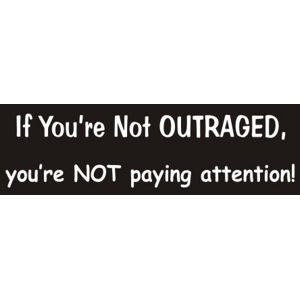
And if you don't see this, you are not paying attention.

* It is a standard stance --a trope?-- in anti-utopians like Molnar and Voegelin that "immanentizing the eschaton" is a Gnostic idea, indeed, a defining Gnostic idea. Gnosis as special insight is a fair assessment, attempting to transcend the world-system through revealed & self-authenticating knowledge. But the second step of trying to implement a social or governmental program to actualize it is pure BS. The essence of Gnosticism is that the world is irredeemable. I would suggest that the totalitarian utopian drives of Marxism and Islam owe far more to Judeo-Christianity than to the Gnostics.  I smell the same infection in contemporary neo-Constantinian "social justice" Christians, who very frequently use the metaphor of "building the Kingdom", a phrase which never, not once, appears in the Bible.

Related Posts Plugin for WordPress, Blogger...