Tuesday, October 11, 2011
Herman & Rick & Mitt
I try not to get too attached to the idea of any particular opponent for the Nov 2012 elections. These things are unpredictable.
And I try to remember Jonah Goldberg's warning that for conservatives, politics is not redemptive. It's a matter of practical wisdom. But the way things are, I'd like someone really wise and really practical. Who reads Newt Gingrich's policy papers. And Paul Ryan's budget.
And btw, nothing I have experienced in the last few weeks has made me think that Universal Suffrage is a good idea.
Them and Ours
I think it was the British historian MacAuley (a later link here, with correct spelling) who noted the Roman Church's solution for keeping schism and heresy to a mimimum. Since it is usually the super-religious rather than the impious who split the Church, Rome has developed Religious Orders for dangerously charismatic individuals and their followers to indulge their special passions and unique enthusiasms while not only remaining within the Fold, but serving it.
Religious Orders therefore have judgments and assessments about other religious orders. From the memoirs of a former Jesuit, who belonged to that Society --one whose charms have always completely eluded me---in the halcyon days before the Vatican Council, this frank appraisal.
Their rules refer to the Jesuits as "this least Society," an expression almost paralyzed with irony. If there is a "least Society" in the bosom of Mother Church, it was assuredly not, on the Jesuits own reckoning, the Society of Jesus. It must be some other confraternity pursuing its own imperfect vision of the religious life. Some were fitfully admired by Ours* in the manner of a connoisseur smiling upon a picturesque ruin, once glorious things like the Benedictines or Dominicans that had fallen into decay. The more remote the ruin, the greater the pretended respect: Carthusians, whom no one had ever seen, were thought to be obscurely worthwhile, but the Franciscans, whatever their imagined service to the Church in the past, were by now unspeakable. Others were mere cartoons: the dimly single-minded like the Passionists; shamelessly self-promoting entrepreneurs like the Maryknollers; the unnumbered hordes of helot brutes posing as Brothers, Christian, Irish Christian, Marist, or whatever; and your parish priest who at least owned up to his inferior status and so won from Ours the same grudging respect that the physician grants to the dentist but withholds from the insolent chiropractor.*Jesuit jargon for "Jesuits".
Monday, October 10, 2011
Columbus Day
My annual note and protest about a day whose meaning has been marginalized and kidnapped by the forces of civilizational dismantling.
I had dinner with a family last night whose now adult children were educated in the Berkeley school system. So today is "Indigenous People's Day". The other days they celebrated were MLK, Malcolm X, Earth Day...the whole sorry panoply.
As I mention each year, it is a sign of decline indeed when the day which used to celebrate the beginning of the civilization of which you are a part now is either passed over in uneasy silence or reversed into an atonement day to the people "we" conquered.
But of course, there is very little "we" left, unravelled in the course of a single generation.
Mine.
A Jewish blogger whom I read has a relative who refuses to celebrate Passover. Because it would mean validating the divine plagues against The Egyptian People, etc. Celebrating his Jewish existence would mean condoning the events which made him possible. And he is so ethical that he will not do that. I wonder if he refuses his birthday because of the pain he caused his mother in childbirth.
There is a stock character we have all seen on TV and in the movies. The Prophet of Doom who announces the destruction of the world because of its sins. And he is gleeful about it. His self-importance and joy come from publishing the downfall of his neighbors at the hands of a Just God who has, of course, chosen him as his spokesman.
As in so many post-modern Western phenomena, I see in the people who avoid Columbus Day or who refused to mark Passover the same kind of split: personal ethical inflation gained by devaluing the collective to which one belongs. And the collectives, themselves without confidence, tolerate or even reward these dismantlers rather than thrashing them soundly and casting them out.
The occasional mad preacher was one thing, but now we have a culture full of self-congratulatory sophisticates who are, in effect, saying Amen --pardon the Christian reference-- to their own erasure.
The problem with these folks, the bien-pensants of the declining West, is that they are too good for this world. Paradoxically, their secular humanism has produced a cohort of angels too pure to remain embedded in the world which shapes them.
Sunday, October 09, 2011
Dreams
What do you think this might be?
A Syrian church in ruins? A mosque in Samarkand? Some royal assembly hall? A dreamer's vision?
I took the liberty of altering the photo just a bit. Here's the original.
It's the Fish Market in Venice...a contemporary photograph by Charles Christopher.
A Syrian church in ruins? A mosque in Samarkand? Some royal assembly hall? A dreamer's vision?
I took the liberty of altering the photo just a bit. Here's the original.
It's the Fish Market in Venice...a contemporary photograph by Charles Christopher.
Genealogy of mortals
Play-texting with a travelling friend this morning, asking him where he intends to go to Mass. "St. Starbucks" was the answer. When queried where Ex Cathedra was going, I replied that after 20 years of Mass every day, I had a free pass for the rest of my life. A quick calculation shows that 20 years of daily Mass equals about 140 years of Sundays. So I guess I'll be going to hell for other reasons...
Speaking of religion.
David Solway's review of Salim Mansur's take-down of multiculturalism, Delectable Lie, passes along (Muslim liberal) Mansur's theory of why the West is destroying itself from within. What are the internal dynamics that fuel the Untergang of the Abendland?
Oedipus and Hamlet.
Using Occam's razor --dreadfully Eurocentric of me-- I have been very impressed with the explanatory power of James Burnham's view that the Western liberal is "morally disarmed in the presence of anyone he deems less fortunate than himself." Once the Western liberal judges someone or some group to be a victim, --and he usually assumes that he, the liberal, is the responsible or at least complicit oppressor--he loses all defense against him. And when the victim eventually shows himself to be developing into a tyrant himself, --the usual outcome--the liberal cannot notice, caught up as he is in a masturbatory ecstasy of ethical righteousness. When the less fortunate victim disembowels him, he refuses to protest. After all, did he not deserve it? Atonement by suicide.
But why was liberalism so able to infect us? My amateur guess is that the alliance between Athens and Jerusalem --which made the West after 476-- was, as are all alliances, unstable. That mix could give it dynamism. And it could compensate each side for the excesses and blindnesses of the other. Liberals will be happy to paint the days when Jerusalem dominated as dark times of oppression and superstition. But what happens to the civilization of Socrates, Oedipus, Hamlet when the triumph of the Enlightenment plays itself out --including deconstructing itself-- without Faith to counter it? First, national and ideological totalitarianism; then chaotic post-modernism: the will to power shaped by nihilist egalitarianism and fueled by a psychotic mix of utopianism and self-hatred.
Burdened by a Christian conscience but bereft of the God and religion that somehow made that conscience bearable, the modern Westerner must be both God and sinner at once: ultimately responsible and irredeemably flawed. Still infected with the disease of Christ's impossible ethics, he rejects the vaccine of the Church. Like his unconscious model, the only way out is to let himself be crucified. But then there is no longer any God to receive his sacrificed life. He offers his life not to an appeasable God but to an unappeasable mob.
Pope Benedict, both in his (in)famous Regensburg speech and since, repeats a very deeply Western (and Catholic) theme, the representative of Jerusalem speaking for Athens: Jerusalem needed, still needs, Athens. But the reverse is also true. Faith without reason leads to superstition. Reason without faith, to relativism. Reason, limited but crucial, offers a necessary corrective to the secular dictatorships of post-modern liberalism and the religious dictatorship of Islam. To the voluntarist* totalitarians of Islam, he asserts the priority of logos over even Divine will. To the egalitarian collectivists of Europe, he asserts the power of reason to reach the real, beyond the fashionably skeptical angst of humanist statism and hedonism.
Anyone who knew me in the 80's would be astonished, as I am, to find me supporting Papa Ratzinger in this. But as I have written elsewhere,
______________________
Speaking of religion.
David Solway's review of Salim Mansur's take-down of multiculturalism, Delectable Lie, passes along (Muslim liberal) Mansur's theory of why the West is destroying itself from within. What are the internal dynamics that fuel the Untergang of the Abendland?
Oedipus and Hamlet.
Both are royal leaders, one a king and the other a prince in succession to the throne. Both wish to purge their kingdoms of corruption, sickness, and the scourge of illegitimacy. Both are driven to find and expose a buried truth so that the realm may be healed and purified.
Critical thought...including self-critical thought...becomes a kind of cancer, cells consuming its own body.
Herein lies the problem and the paradox, for in seeking to disinter what is hidden or suppressed, both Oedipus and Hamlet in their diverse ways bring disaster upon themselves, one as a result of a relentless pursuit and the other owing to relentless reflection. One acts and the other fails to act, but the consequences are no less destructive: blindness and death.
Using Occam's razor --dreadfully Eurocentric of me-- I have been very impressed with the explanatory power of James Burnham's view that the Western liberal is "morally disarmed in the presence of anyone he deems less fortunate than himself." Once the Western liberal judges someone or some group to be a victim, --and he usually assumes that he, the liberal, is the responsible or at least complicit oppressor--he loses all defense against him. And when the victim eventually shows himself to be developing into a tyrant himself, --the usual outcome--the liberal cannot notice, caught up as he is in a masturbatory ecstasy of ethical righteousness. When the less fortunate victim disembowels him, he refuses to protest. After all, did he not deserve it? Atonement by suicide.
But why was liberalism so able to infect us? My amateur guess is that the alliance between Athens and Jerusalem --which made the West after 476-- was, as are all alliances, unstable. That mix could give it dynamism. And it could compensate each side for the excesses and blindnesses of the other. Liberals will be happy to paint the days when Jerusalem dominated as dark times of oppression and superstition. But what happens to the civilization of Socrates, Oedipus, Hamlet when the triumph of the Enlightenment plays itself out --including deconstructing itself-- without Faith to counter it? First, national and ideological totalitarianism; then chaotic post-modernism: the will to power shaped by nihilist egalitarianism and fueled by a psychotic mix of utopianism and self-hatred.
Burdened by a Christian conscience but bereft of the God and religion that somehow made that conscience bearable, the modern Westerner must be both God and sinner at once: ultimately responsible and irredeemably flawed. Still infected with the disease of Christ's impossible ethics, he rejects the vaccine of the Church. Like his unconscious model, the only way out is to let himself be crucified. But then there is no longer any God to receive his sacrificed life. He offers his life not to an appeasable God but to an unappeasable mob.
Pope Benedict, both in his (in)famous Regensburg speech and since, repeats a very deeply Western (and Catholic) theme, the representative of Jerusalem speaking for Athens: Jerusalem needed, still needs, Athens. But the reverse is also true. Faith without reason leads to superstition. Reason without faith, to relativism. Reason, limited but crucial, offers a necessary corrective to the secular dictatorships of post-modern liberalism and the religious dictatorship of Islam. To the voluntarist* totalitarians of Islam, he asserts the priority of logos over even Divine will. To the egalitarian collectivists of Europe, he asserts the power of reason to reach the real, beyond the fashionably skeptical angst of humanist statism and hedonism.
Anyone who knew me in the 80's would be astonished, as I am, to find me supporting Papa Ratzinger in this. But as I have written elsewhere,
“I'd rather go to the ramparts with the irascible folks who want to save our town from the invading barbarians than stay at home with the charming pacifist intellectuals who argue about re-designing the bedroom.”
______________________
*The Catholic settlement about faith and reason --which will always be a matter of dispute about individual cases as history moves along-- is that God is the Truth, Logos, and so faith and reason, both from God, cannot contradict each other. Faith goes beyond reason but may not go against reason. Lutheran fideism in the West (which led to Kant?) separates the two entirely. In Islam, the rationalists (mutazili) lost the battle to the (Asherites) theologians by 1000 AD.
Saturday, October 08, 2011
A queen
Quentin Crisp is not a hero of mine, no oracle or role model. My chief remembrance of him is his description of The Great Dark Man, the impossible masculine ideal whose pursuit, he held, made homosexuals incapable of happiness. Of himself he said:
I think this is called aporia, or in plain English, a dead end.
An Englishman in New York dramatizes The Naked Civil Servant's last years, in America. Much of it unfolded around the newborn plague of AIDS. I like to forget what a horror that was, the hospital rooms, the funerals. The film made clear his missteps about reading the epidemic, dismissing it as "a fad" and suffering the rejection of the subculture that had come to lionize him.
I found myself watching John Hurt's portrayal of Quisp as if I were listening to a patient. That made him less offputting. In the film, his combination of exhausted solipsistic nihilism and witty patter, by themselves very quickly wearing, were made bearable by his inconsistency, which showed itself in kindness. (I have been told that inconsistency is also what makes me bearable.) And if he was brave, it was the courage of those who have no hope.
I was surprised, though, by how much I was taken with and moved by the character of Patrick Angus, the doomed young painter who'd already given up hope of being loved.
Perhaps it was the actor, Jonathan Tucker*, I was taken with...
There were the usual predictable political assumptions, but the film was also very unromantic about the flaws of the newly-born gay culture. Liberation brought neither virtue nor happiness.
*2015, update. Mr Tucker played a 180 degree opposite character very convincingly in the final season of Justified: a completely sociopathic and sadistic hired gun for the Bad Guy. Scary and crazy and nasty.
If I were to find my Great Dark Man, he would not love someone like me.The Great Dark Man is the Real Man. And by his definition, the Real Man would never fall in love with someone of his own sex. So said Quisp.
And if he were to love someone like me, then he could not be my Great Dark Man.
I think this is called aporia, or in plain English, a dead end.
An Englishman in New York dramatizes The Naked Civil Servant's last years, in America. Much of it unfolded around the newborn plague of AIDS. I like to forget what a horror that was, the hospital rooms, the funerals. The film made clear his missteps about reading the epidemic, dismissing it as "a fad" and suffering the rejection of the subculture that had come to lionize him.
I found myself watching John Hurt's portrayal of Quisp as if I were listening to a patient. That made him less offputting. In the film, his combination of exhausted solipsistic nihilism and witty patter, by themselves very quickly wearing, were made bearable by his inconsistency, which showed itself in kindness. (I have been told that inconsistency is also what makes me bearable.) And if he was brave, it was the courage of those who have no hope.
I was surprised, though, by how much I was taken with and moved by the character of Patrick Angus, the doomed young painter who'd already given up hope of being loved.
Perhaps it was the actor, Jonathan Tucker*, I was taken with...
There were the usual predictable political assumptions, but the film was also very unromantic about the flaws of the newly-born gay culture. Liberation brought neither virtue nor happiness.
*2015, update. Mr Tucker played a 180 degree opposite character very convincingly in the final season of Justified: a completely sociopathic and sadistic hired gun for the Bad Guy. Scary and crazy and nasty.
Roku wrongo in Black and White
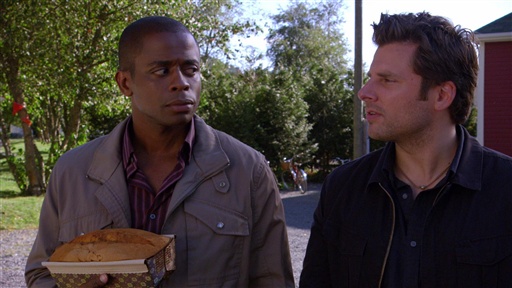
Gus and Shawn with cinnamon Monkey Bread
Via Roku, I can watch all 79 episodes of Psych. I chose Dual Spires, the quirky take-off on Twin Peaks where the boys investigate a suspicious death during the Cinnamon Festival in a town so small its name on the map is in parentheses.
A small moment indicates some of what is wrong with our current social contract. Gus tells Shawn that he wants to get out of the little rural burg because "it has no cell phone service and it's all fulla white people."
This is supposed to be amusing and we are supposed to sympathize with Gus and feel a little bad about such a retrograde whitebread place. But imagine a switch, where Shawn* wants to leave somewhere because "it's all fulla black people." Now we'd have An Important Moral Issue on our hands. And Shawn would suddenly be a reprobate.
Hey, I can't help it. I'm a shrink; we notice small things.
In this case it's "Black Privilege", the ability of any Black --from your local homeless drug addict to Oprah and Obama--to take the position of a victimized minority, for any reason, at which point the job of Whites is to feel embarrassed and sympathetic and, above all, not be critical.
Reminded me of a vacation with my ex years ago, spoiled partly because he freaked out that Portland, Oregon was so white. No one was anything but polite to him. Just that demographic fact seemed to give him some kind of justification for judging and acting out. If I had responded similarly in Harlem or Bayview-Hunters Point in SF, there'd have been all hell to pay.
As I've said before, the real basis of the multicultural myth is that Caucasians must never be left alone in groups; Whites in a group by themselves are intrinsically pathological**. And what is so distressing is that Whites play along with this and enforce it on one another, when the evidence suggests something quite the contrary.
As Shelby Steele pointed out, the current creepy agreement between Whites and Blacks is that Whites can rent some racial innocence if they grant Blacks a lot of licence and deference. Which, however, Blacks can rescind at any time. It's a weird and unreal social and moral reversal. Very unhealthy.
But the rest of the episode was funny.
*The pilot episode was in 2006. James Roday, who is still sexy, has gotten a big chunky since then. Back in 06 he was even moreso. Sexy, that is.
**Like all male groups, etc. Without the redeeming presence of wymyn, they are patriarchal old boy clubs. Even the locker rooms of men's sports teams must be open to female reporters.
Surplices in a knot
Ordinary people sometimes get their knickers in a knot. The very serious liberal liturgists at PrayTell --yes, I relapsed and read a page-- have their surplices in a knot. Which they always do, but this time it is over two phrases in retranslated liturgy.
In one of the Eucharistic Prayers, the phrase a solis ortu usque ad occasum occurs. Literally, from the rising of the sun unto its setting. It's a quote from the prophet Malachi 1.11 about sacrifice. The phrase can also be interpreted as from east to west, which is what the lame-duck text says. The vast majority of Bibles in English and other languages choose the temporal rather than spatial interpretation. The PrayTell crowd are expending a lot of energy on the change. They sound like conservatives who hate change because it's, well, change.
And in the common prayers before communion, the Latin says Domine non sum dignus ut intres sub tectum meum sed tantum dic verbo et sanabitur anima mea. Literally, Lord, I am not worthy that you should enter under my roof but only say the word and my soul shall be healed. It's quote from the Gospels, when a Roman centurion humbly declines Jesus' offer to go to the man's house to heal his sick servant. The soon to be replaced 1973 translation extracted the metaphor and simply said, Lord I am not worthy to receive you... The experts are afraid that "the people" --whom they want to empower but evidently also deem to be idiots-- will think it means the roof of their mouth.
Supposed the 1973 version had kept the biblical quote intact and the new one wanted to simplify it to "receive you"? Can't you hear the very same people yelling that Rome was suppressing the scriptural voice? Babies.
Yom Kippur Confiteor
Isidore Kaufmann, c. 1900
Today is the Jewish Day of Atonement, total fasting and day-long prayer to ask forgiveness of the past year's sins.
Recreation of the rite by the Temple Institute in Jerusalem
When the Jerusalem Temple existed, the high priest entered the Holy of Holies only on this day, with sacrificial blood, and spoke the four-letter Divine Name out loud, which was forbidden everywhere else and to everyone else.
It's a rich and strange word, atonement. We hear it first now in English as "reparation", as making up for some wrong. The English word itself does appear to mean "at-one" ment, unification. Making up for some wrong in order to create communion.
In Christianity, The Atonement --Christ's death on the cross as a sacrifice to God for mankind's sins--is the most humanly resonant archetype in the library but for Enlightened Westerners, the most scandalous and embarrassing. The Epistle to the Hebrews connects the High Priest's ritual with Jesus' crucifixion.
This Slovak crucifixion ikon shows Christ's blood descending on the skull of Adam,
whom legend says was buried beneath Golgotha, the Place of the Skull.
Like most of our basic emotions and moods, guilt eludes our attempts to domesticate it. I have found it very ironic that the liberal culture which mocks the primitivity of "Original Sin" triumphantly grants me liberation from guilt about my sexual life then wants me to feel eternally guilty for societal wrongs done to strangers long before I was born.
A deceased Unitarian friend once told me the difference between the different kinds of Western guilt:
Catholics feel guilty for what they do, Jews feel guilty for what they don't do, and Protestants feel guilty just for not being nice enough.
The Confiteor ("I confess") is a part of the preparatory prayers of the Mass. I remember having to learn the Roman version in Latin as a boy; very complex because the case endings on the twice-spoken saints' name list there --blessed Mary ever Virgin, blessed Michael the Archangel, blessed John the Baptist, the holy Apostles Peter and Paul-- changed from first to second recitiation, from dative to accusative. Quite a mouthful of nuance. And the threefold striking of the breast with the words, "mea culpa, mea culpa, mea maxima culpa".
Here's the Dominican Order's version. Fewer saints and culpa's but more detail in the sins: thought, speech, deed and omission.
As you would expect from an introverted thinking type, most of the sins of which I feel are in thought and omission. Omission especially. As the recent English translation of "opere et omissione" makes clear: "...what I have done and what I have failed to do."
To my Jewish friends today, "an easy fast".
Friday, October 07, 2011
Screaming angels
The Blue Angels, that is. It's Fleet Week again in San Francisco. The noise of the low-flying jets over the city makes dogs and liberals crazy, but I think they're beautiful.
(The jets, not the liberals.)
My dad was a Navy pilot who stayed in the Reserve after the war. One Saturday while he was away on active duty, my mom made us kids stand out in the backyard and look up at the sky. A single jet flew over and dipped its wings. It was Dad.
(The jets, not the liberals.)
My dad was a Navy pilot who stayed in the Reserve after the war. One Saturday while he was away on active duty, my mom made us kids stand out in the backyard and look up at the sky. A single jet flew over and dipped its wings. It was Dad.
Subscribe to:
Posts (Atom)